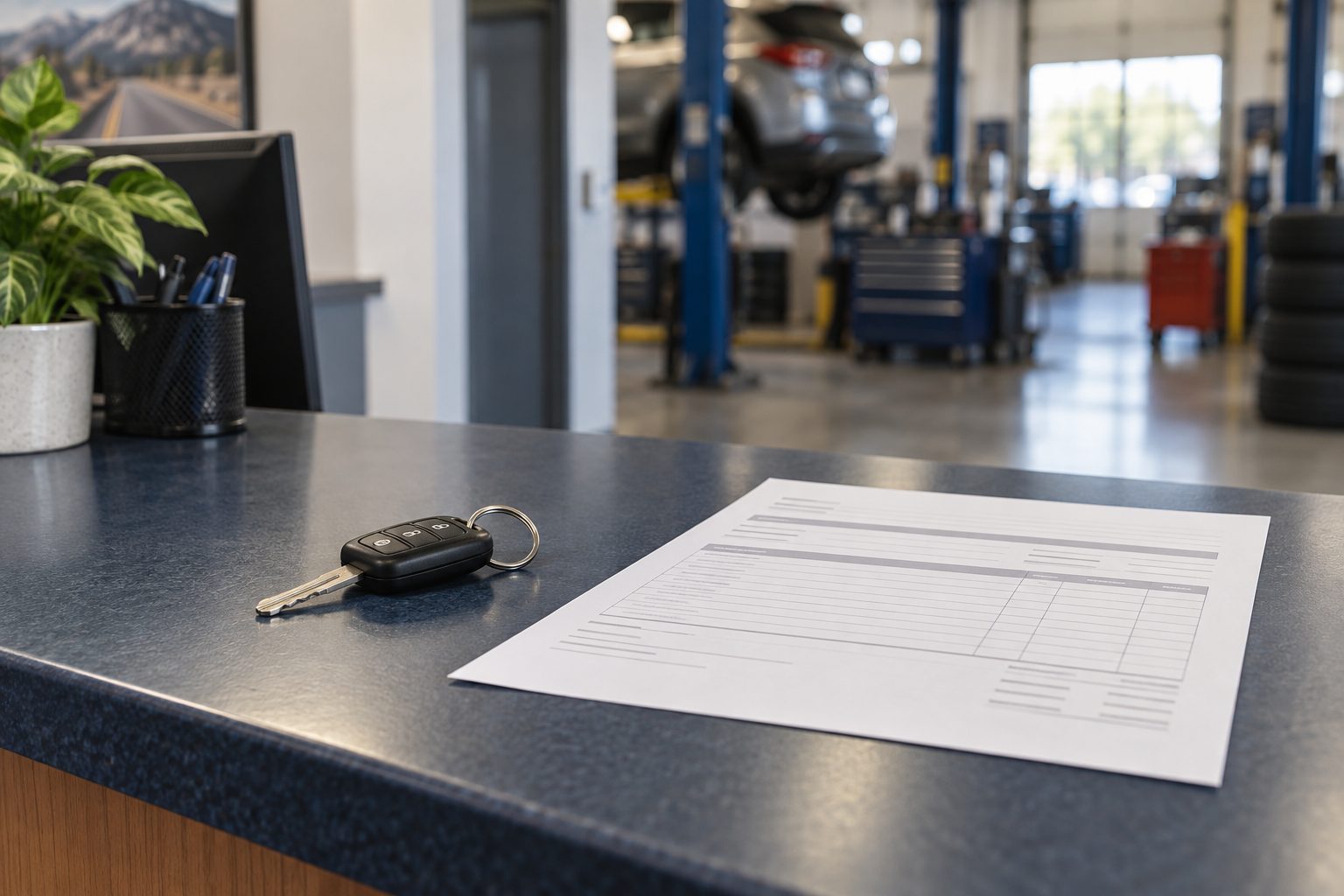
Before borrowing for a car repair, confirm what needs fixing, obtain a written estimate and check whether any existing warranty or coverage applies. Then compare financing using the total repayment and the dates you will owe money. A repair can be necessary without every financing option being suitable.
This checklist addresses the financial paperwork, not vehicle diagnosis or driving safety. Ask a qualified technician whether the vehicle can be used safely and what work is urgent. Do not postpone a safety decision because a budgeting example suggests waiting might be cheaper.
Confirm what the proposed work is meant to fix
Ask the shop to describe the problem in plain language and connect each proposed repair to it. A list of parts is less useful than an explanation of what failed, what was inspected and what remains uncertain. Keep diagnostic work separate from repairs that have not yet been authorized.
The FTC's auto-repair guidance recommends a written estimate and suggests considering another opinion for expensive or complicated repairs. It also advises checking diagnostic charges and understanding warranty limitations. These are useful starting questions; state requirements and the particular repair agreement may differ.
If a second opinion is practical, compare the scope as well as the price. Two quotes may describe different work, different parts or different assumptions. A cheaper total is not automatically an equivalent repair, and a higher total is not proof that the extra work is necessary.
Write down the technician's explanation while it is fresh. If you cannot explain which problem the repair addresses, ask again before signing a financing agreement tied to the work. Financing can make a bill easier to spread out without making an unclear repair recommendation clearer.
Read the estimate as a set of commitments
Identify the parts, labor, diagnostic charges and any other listed costs. Ask which amounts are fixed and which are estimates. If taxes or fees are excluded, request an explanation of how they affect the expected final amount. Keep a copy of the version you reviewed.
Ask what happens if the shop discovers more work after starting. Agree on how you will be contacted and what requires additional authorization under the applicable arrangement. Do not assume that approving an initial estimate also answers every question about later changes.
Compare the estimate with your available funds before seeking a loan amount. Borrowing from a rough verbal figure can leave you with either insufficient funds or unnecessary debt. If the total cannot yet be known, identify the remaining uncertainty rather than adding an arbitrary cushion without examination.
Keep repair approval and financing approval conceptually separate. One concerns the work; the other concerns how you pay. Read both documents even when the shop presents them together. Ask which company is responsible for each agreement and where questions should be directed.
Check coverage you may already have
Review any vehicle warranty, service contract or other relevant coverage documents. Confirm whether the particular repair is covered, whether authorization is required and where the work must be performed. Do not assume a product called a warranty covers every breakdown or reimburses every charge.
Ask who pays the shop and when. A reimbursement arrangement can leave an immediate cash need even if some cost is later covered. Record any deductible, excluded amount and documentation required for a claim. Treat an expected reimbursement as uncertain until it is confirmed.
If coverage is disputed, keep the explanation and ask about the official review process. A financing decision should not silently turn an unresolved coverage question into an accepted personal cost. At the same time, do not assume that a dispute suspends the shop's payment requirements; ask directly.
Avoid buying an additional product merely because it is bundled into a monthly payment. Identify what it costs, what it covers and whether it is optional. A product that addresses future repairs is a different decision from paying for the repair currently in front of you.
Separate the repair deadline from sales pressure
Ask when the work can start, when the car is expected to be ready and when payment is required. Those dates determine the actual funding need. An estimate that expires soon is not the same as a mechanical requirement to make an immediate borrowing decision.
If the vehicle is essential for work or caregiving, include the practical effects of downtime. Temporary transport may have a cost, but that does not make every offered loan acceptable. Put the expense into the comparison so you can see it clearly rather than using urgency as a substitute for calculation.
Confirm whether storage, towing or diagnostic costs apply while you decide. Request the relevant terms in writing. Do not assume a vehicle can remain at a shop indefinitely without charge, and do not infer a charge from this article where the shop has not stated one.
Be cautious about promises that financing is “easy” or “guaranteed.” Ask for the actual agreement and the identity of the lender. A shop's familiarity with a finance provider does not remove your need to review costs and verify whom you will owe.
Compare the payment method and the total obligation
Possible arrangements differ: paying from available funds, a direct shop payment plan or borrowing from a separate provider. Not every option is available in every case. For each real option, record the amount due immediately, later payments, fees and conditions.
For a loan, review the amount you receive, APR, repayment term and total of payments. If fees reduce the cash disbursed, confirm that the net amount covers the bill. Use the personal loan comparison guide to avoid comparing only the advertised monthly payment.
If a promotional financing arrangement is offered, ask what happens when the promotional period ends and what conditions apply. Do not translate an advertising phrase into a promise of zero total cost. Read the written terms and ask the provider to explain any deferred-interest or other conditional feature.
Check whether the agreement is secured and what property, if any, is pledged. The repair itself does not answer that question. Also ask when funds become available; an estimated approval or transfer time is not proof that the shop will receive money by its deadline.
Include costs beyond the repair line
Imagine a fictional repair estimate of $1,100, a separately confirmed $90 diagnostic charge and $60 of necessary temporary transport. The immediate problem totals $1,250 before any financing costs. If the diagnostic charge is already included in the estimate, adding it again would overstate the need.
Create a small worksheet showing each item, whether it is included elsewhere and when it must be paid. This prevents both omissions and double counting. Replace provisional figures with the final invoice as soon as it is available.
Now add the proposed repayments to your household calendar. A payment may look manageable until it lands alongside insurance, rent or an existing vehicle payment. Check the first due date and a slower-income scenario rather than relying solely on a normal month.
Consider how long the repayment would continue relative to your expectations for the vehicle. That is a planning question, not a prediction of the car's remaining life. Ask a qualified professional about the vehicle's condition and avoid assuming that a new repair eliminates all future costs.
Keep the final documents together
After the work, compare the invoice with the approved estimate and documented changes. Ask about discrepancies promptly. Keep the repair description, payment receipt and any written warranty terms together so a later question does not depend on memory.
If financing paid the shop directly, verify both sides: the shop's receipt of payment and the lender's account details. Do not assume one confirmation establishes the other. Record the first payment date and the official service contact for the financial agreement.
Review the actual cost against your original worksheet. The difference can help you plan future maintenance and reserves, but it should not become a reason to blame yourself for an unexpected failure. The useful outcome is better information and a clear repayment record.
Read About FCF Brandon for the site's status. This educational checklist is not a financing offer, and online loan applications here are inactive. Bring the written estimate and your questions to a provider you independently verify before making a commitment.
Make your next conversation count
Bring a written comparison and ask about any figure you cannot reconcile before signing.
Prepare your questions